The 10 Commandments


Summary
This guide traces the 10 Commandments through the Bible’s larger story, showing how they aim to increase human freedom and flourishing life. By integrating details from ancient context and literary ties across Scripture, this guide exposes the deeper wisdom within each command. See how Israel’s prophets used these instructions to guide people back to God, and discover the ways Jesus and New Testament authors teach the 10 Commandments not to control but to cultivate wisdom. These words from God intend to form those who listen into people compelled by the love of God.
What Are the Commands of God For?
We might wonder whether God’s commands are arbitrary or outdated rules—do’s and don’ts meant to keep people in line. But seen in their literary context as part of Scripture’s larger story, they reveal life-giving wisdom. God’s first two commands in the Bible set a foundation for all that follows.
After blessing humans with life during creation, Yahweh first instructs them to create more life: “Be fruitful and multiply and fill the land” (Gen. 1:28 BibleProject Translation). He then invites them to enjoy his abundant creation: “From every tree of the garden”—including the tree of life—“you may surely eat, but from the tree of the knowledge of good and bad you shall not eat” (Gen. 2:16-17 BibleProject Translation). The tree was not poisonous (see Gen. 3:6). So why command them to avoid it?
The two trees represent a choice humanity faces: to trust God’s wisdom or not. Eating from the tree of life is about trusting God’s wisdom, while eating from the forbidden tree is a choice to rely on one’s own understanding. Doing that leads to death. So, from the beginning, God’s commands intend to enliven people and keep humanity flourishing. This same principle carries through every divine instruction: God’s instruction always directs people into freedom and life.


Like all of Scripture’s commands, the 10 Commandments ultimately reveal God’s character. Meditating on the wisdom within them helps readers understand God’s love and design for creation. People have treasured these commands since God gave them through Moses at Mount Sinai.
As Moses nears death, he presents to the Israelites the same choice the first humans faced in Eden: life or death. Choosing to love God and obey his commands is choosing life (Deut. 30:11-20). Every instruction God gives points toward flourishing, as the psalmist affirms, “Direct me in the path of your commands, for there I find delight” (Ps. 119:35 NIV), and “I will never forget your precepts, for by them you have preserved my life” (Ps. 119:93 NIV).
What Is the Context of the 10 Commandments?
The Israelites receive these commands after God rescues them from centuries of slavery in Egypt. They are en route to the promised land, and God meets with them at Mount Sinai.
Standing at the foot of the mountain, the people tremble at the sight of God’s glory. Fiery smoke curls above them. Thunder shakes the ground. There, God invites them into a covenant relationship, a mutual agreement, promising that if they agree to walk in his ways, they will be his “treasured possession” and will live as his representatives before the nations (Exod. 19:5-6). The Israelites accept his offer, pledging to “do everything Yahweh has said” (Exod. 19:8 BibleProject Translation).


Then God speaks the 10 Commandments from the fiery summit and inscribes them onto stone tablets (Exod. 31:18). These are a gift for freedom, not a rulebook for restriction. They’re meant to shape people into a community that reflects God’s own character. By keeping these commands, the Israelites will fulfill their side of the agreement with God and embody the wisdom and care of their creator. And they will show others how to find real life through loving God and extending that love to all neighbors (see Matt. 22:36-40).
Notice, too, that the 10 Commandments begin with “I am Yahweh your Elohim, who brought you out of the land of Egypt, out of the house of slavery” (Exod. 20:2 BibleProject Translation). The idea: I’m not commanding to control but giving words of wisdom to set you free, which I’ve already done in a mighty way. I can be trusted, Yahweh is saying. These instructions come from love, and they will enable you to live.
These commands will teach the Israelites how to live as God’s people, not Pharaoh’s slaves. God designed the commands to create a society rooted in freedom—where all can thrive as they become a community of justice, mercy, and love.


Where Does the Term “Decalogue” Come From?
The 10 Commandments are often called the “Decalogue,” from the Greek deka logous, which means “10 words.”
Important note: The Hebrew Bible never calls them “commandments” but instead refers to them as “the 10 words” (Hebrew: ‘aseret haddevarim, Exod. 34:28; Deut. 4:13, 10:4). Modern Jewish traditions preserve this meaning by calling these commands the “10 Statements” or “10 Words.”
The phrase “10 Commandments” appears as early as the 3rd century CE, in Origen’s Homilies on Exodus. Many modern translations use that title because these words are directives that God “commands” (Hebrew: tsivvah) Israel to follow (Deut. 4:13). And in the New Testament, both Jesus and Paul refer to some Decalogue stipulations as “commandments” (Greek: entole, Matt. 15:3-4, 19:17-19; Rom. 13:9).
So “commandments” is an appropriate term, but thinking of them as “words” or “statements” highlights their relational nature. The Decalogue presents God’s words of life, which guide a people rescued from oppression toward free flourishing rather than coerced obedience.

Why Are There Two Versions of the 10 Commandments, and How Are They Different?
Approximately 40 years after God spoke the 10 Commandments to the Israelites amid fiery thunder on Mount Sinai (Exod. 20:1-19), Moses restates them for a new generation preparing to enter the promised land (Deut. 5:6-21).
But the lists aren’t identical. The Exodus version links the Sabbath command to God’s own seventh-day rest at creation (Exod. 20:11; Gen. 2:2-3). In Deuteronomy, the Sabbath is tied to Israel’s exodus from Egypt (Deut. 5:15), reminding the next generation, who did not experience brutal slavery, to extend rest to others and not become like the oppressive Pharaoh.
The end of the Decalogue also differs subtly. Exodus 20:17 says, “Do not desire (Hebrew: khamad)”:
- “Your neighbor’s house”
- “Your neighbor’s wife” or any of his possessions
Deuteronomy 5:21 reverses the order:
- “Your neighbor’s wife”
- “Your neighbor’s house” or any of his possessions
Separating out the neighbor’s wife highlights a clear set of parallels in Deuteronomy 5:17-21:
- Do not kill (Deut. 5:17) // Do not bear false witness (Deut. 5:20), which can destroy the life of an innocent person
- Do not commit adultery (Deut. 5:18) // Do not desire your neighbor’s wife (Deut. 5:21a)
- Do not steal (Deut. 5:19) // Do not desire your neighbor’s possessions (Deut. 5:21b)
Also, Deuteronomy adds a different verb in the second line: “Do not crave (’avah).” By combining khamad and ’avah, this version echoes the Eden story in Genesis 3, which uses the same Hebrew roots to describe how Eve sees that the tree of knowing good and bad is “craveable (ta’avah) to the eyes” and “desirable (nekhmad) for gaining wisdom” (Gen. 3:6 BibleProject Translation). This connection invites reflection on the difference between good human desire and destructive craving, highlighting the true wisdom of trusting God’s guidance.
Together, these two versions of the 10 Commandments show that God’s instructions are rooted in creation, shaped by history, and designed to cultivate wise, life-giving choices for every generation.
How Are the 10 Commandments Numbered?
Exodus 20:2-17 contains more than 10 directives. But the Bible describes it as “10 words” (Exod. 34:28; Deut. 4:13, 10:4). So how are we supposed to count to 10? There’s no one obvious way to number the 10 Words, so different traditions approach it in various ways.

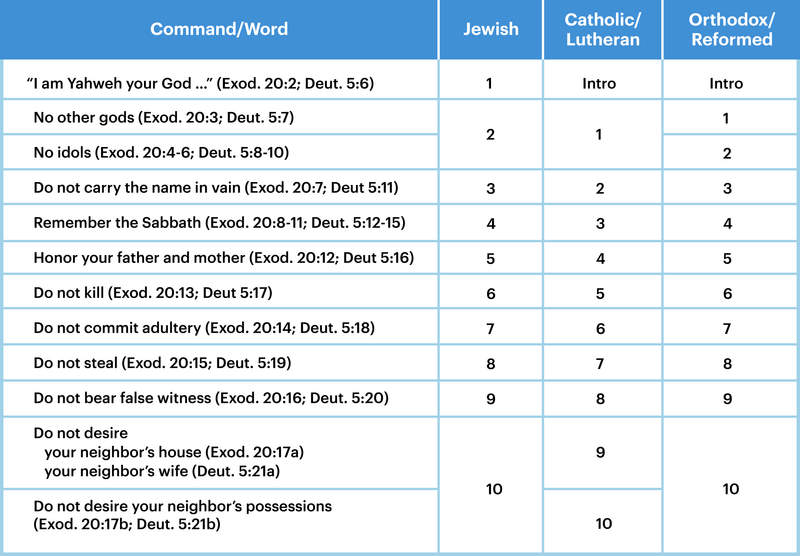
Notice how the differences between the various numbering traditions appear at the beginning and end of the Decalogue.
- Jewish tradition counts the opening statement about God rescuing Israel from slavery in Egypt as the first of the 10 Words. In this counting, the first word is not a command. Instead, it provides the basis for God’s covenant relationship with Israel.
- Jewish, Roman Catholic, and Lutheran traditions combine the prohibitions against having other gods and making idols into one single command. Orthodox and Reformed traditions, however, identify these as two separate commands.
- The Roman Catholic and Lutheran traditions consider the prohibition of misdirected desire to be two separate commands. The Catholic tradition follows the Deuteronomy version of the Decalogue, so the ninth word is “Do not desire your neighbor’s wife” (Deut. 5:21a). In the Lutheran tradition, which follows the Exodus version, the ninth word prohibits desiring “your neighbor’s house” (Exod. 20:17a).
While each of these numbering traditions offers valuable insight, we have developed this guide according to the Orthodox/Reformed tradition.
Dive Deeper
Read
20 Then God spoke all these words, saying,
2 “I am the Lord your God, who brought you out of the land of Egypt, out of the house of slavery.
3 “You shall have no other gods before Me.
18 To whom then will you liken God?
Or what likeness will you compare with Him?
19 As for the idol, a craftsman casts it,
A goldsmith plates it with gold,
And a silversmith fashions chains of silver.
20 He who is too impoverished for such an offering
Selects a tree that does not rot;
He seeks out for himself a skillful craftsman
To prepare an idol that will not totter.
21 Do you not know? Have you not heard?
Has it not been declared to you from the beginning?
Have you not understood from the foundations of the earth?
22 It is He who sits above the circle of the earth,
And its inhabitants are like grasshoppers,
Who stretches out the heavens like a curtain
And spreads them out like a tent to live in.
23 It is He who reduces rulers to nothing,
Who makes the judges of the earth meaningless.
24 Scarcely have they been planted,
Scarcely have they been sown,
Scarcely has their stock taken root in the earth,
But He merely blows on them, and they wither,
And the storm carries them away like stubble.
25 “To whom then will you compare Me
That I would be his equal?” says the Holy One.
26 Raise your eyes on high
And see who has created these stars,
The One who brings out their multitude by number,
He calls them all by name;
Because of the greatness of His might and the strength of His power,
Not one of them is missing.
27 Why do you say, Jacob, and you assert, Israel,
“My way is hidden from the Lord,
And the justice due me escapes the notice of my God”?
28 Do you not know? Have you not heard?
The Everlasting God, the Lord, the Creator of the ends of the earth
Does not become weary or tired.
His understanding is unsearchable.
29 He gives strength to the weary,
And to the one who lacks might He increases power.
30 Though youths grow weary and tired,
And vigorous young men stumble badly,
31 Yet those who wait for the Lord
Will gain new strength;
They will mount up with wings like eagles,
They will run and not get tired,
They will walk and not become weary.
11 “Has a nation changed gods,
When they were not gods?
But My people have exchanged their glory
For that which is of no benefit.
12 “Be appalled at this, you heavens,
And shudder, be very desolate,” declares the Lord.
13 “For My people have committed two evils:
They have abandoned Me,
The fountain of living waters,
To carve out for themselves cisterns,
Broken cisterns
That do not hold water.
Consider
The 10 Commandments begin with a memory: “I am the LORD your God, who brought you out of the land of Egypt, out of the house of slavery” (Exod. 20:2). Remember, Israel, that these 10 are from God, and you know he is 100 percent for you. Only then follows the command, “You shall have no other gods before me” (Exod. 20:3). The order matters. Yahweh’s law begins not with coercion, but with memory of God’s proven love.
In the ancient Near East, loyalty to multiple deities was normal. Nations identified themselves through a pantheon of gods that governed every sphere of life. In contrast, Israel’s God calls for exclusive devotion. Not only is he the only God who has proven himself faithful to Israel, but he’s the God who created everything that exists. Nothing and no one can compare to him (Isa. 40:25-26).
The phrasing “no other gods before me” does not outright deny the existence of other powers, but forbids anyone in Israel from trusting them. The command draws a line. Israel’s freedom from Egypt must not lead to new forms of dependence on rival deities or systems of control, “other gods.”
This ancient command exposes deeper wisdom and questions about allegiance. Yahweh’s power is unrivaled—he’s the God who rescues his people and strengthens the weak (Isa. 40:28-31). Giving allegiance to other gods is futile because they’re empty and powerless. While Yahweh is “the fountain of living waters,” other gods are like “broken cisterns that do not hold water” (Jer. 2:13). They promise life but can’t deliver.
Where fragmented allegiance exhausts and enslaves, the first commandment rescues. It challenges the human impulse to hedge bets across many securities—or gods—and instead calls for a singular center of trust.
By recalling Israel’s liberation from slavery in Egypt, Exodus 20:1-3 portrays devotion to God not as restrictive but as protective. It guards freedom by keeping what is ultimate in its rightful place. To serve one God is, paradoxically, to be truly free.
Reflect
If God is both the one who made Israel and the one who rescued them, what does that say about why he gives them these commands?
More Relevant Scripture References
- Exodus 15:1-11
- Deuteronomy 4:5-8
- Joshua 24:14-27
- Psalm 86:6-10
- Psalm 89:5-14
- Jeremiah 10:11-16
- Micah 7:18-20
Read
4 “You shall not make for yourself an idol, or any likeness of what is in heaven above or on the earth beneath, or in the water under the earth. 5 You shall not worship them nor serve them; for I, the Lord your God, am a jealous God, inflicting the punishment of the fathers on the children, on the third and the fourth generations of those who hate Me, 6 but showing favor to thousands, to those who love Me and keep My commandments.
6 “This is what the Lord says, He who is the King of Israel and his Redeemer, the Lord of armies:
‘I am the first and I am the last,
And there is no God besides Me.
7 ‘Who is like Me? Let him proclaim and declare it;
And, let him confront Me
Beginning with My establishing of the ancient nation.
Then let them declare to them the things that are coming
And the events that are going to take place.
8 ‘Do not tremble and do not be afraid;
Have I not long since announced it to you and declared it?
And you are My witnesses.
Is there any God besides Me,
Or is there any other Rock?
I know of none.’”
9 Those who fashion an idol are all futile, and their treasured things are of no benefit; even their own witnesses fail to see or know, so that they will be put to shame. 10 Who has fashioned a god or cast an idol to no benefit? 11 Behold, all his companions will be put to shame, for the craftsmen themselves are mere men. Let them all assemble themselves, let them stand up, let them tremble, let them be put to shame together.12 The craftsman of iron shapes a cutting tool and does his work over the coals, fashioning it with hammers and working it with his strong arm. He also gets hungry and his strength fails; he drinks no water and becomes weary. 13 The craftsman of wood extends a measuring line; he outlines it with a marker. He works it with carving knives and outlines it with a compass, and makes it like the form of a man, like the beauty of mankind, so that it may sit in a house. 14 He will cut cedars for himself, and he takes a holm-oak or another oak and lets it grow strong for himself among the trees of the forest. He plants a laurel tree, and the rain makes it grow. 15 Then it becomes something for a person to burn, so he takes one of them and gets warm; he also makes a fire and bakes bread. He also makes a god and worships it; he makes it a carved image and bows down before it. 16 Half of it he burns in the fire; over this half he eats meat, he roasts a roast, and is satisfied. He also warms himself and says, “Aha! I am warm, I have seen the fire.” 17 Yet the rest of it he makes into a god, his carved image. He bows down before it and worships; he also prays to it and says, “Save me, for you are my god.”
18 They do not know, nor do they understand, for He has smeared over their eyes so that they cannot see, and their hearts so that they cannot comprehend. 19 No one remembers, nor is there knowledge or understanding to say, “I have burned half of it in the fire and also have baked bread over its coals. I roast meat and eat it. Then I make the rest of it into an abomination, I bow down before a block of wood!” 20 He feeds on ashes; a deceived heart has misled him. And he cannot save himself, nor say, “Is there not a lie in my right hand?”
Consider
The second commandment forbids Israel from making idols. They often represent other gods, and as the previous command makes clear, Israel belongs to Yahweh alone. Their loyalty isn’t up for grabs.
According to Exodus 20:5, idols provoke God’s jealousy—a response of love under threat—suggesting deep attachment between God and people. Turning to idols is betrayal, breaking the life-giving attachment. Notice that God’s jealous response is not about his honor: God’s bond with humanity gives life, so he wants it to endure and never break.
Isaiah describes idol worship as absurd, mocking the irony: A person chops wood, uses part of it to cook dinner, and with the rest carves a “deity” to bow before (Isa. 44:9-17). It’s both ridiculous and tragic, honoring something dead, trusting a lifeless thing for life.
Isaiah 44:18 suggests further that those who trust in idols become blind like the statues they serve. In the view of the biblical authors, we become like what we worship (see Ps. 135:15-18). So whatever people make to stand in God’s place will eventually corrupt them.
But the second command prohibits not only making idols of other gods but also making an image of Yahweh himself. At Mount Sinai (also called Horeb), Israel never saw God’s form but only heard his voice (Deut. 4:15-18). To create a physical image of him would be to shrink the invisible, limitless God down to something manageable—and false. Idols that can’t see or hear can’t represent the living God. Instead, God created his own images—people—to embody his presence in the world (Gen. 1:26-27).
Reflect
What does Isaiah 44:6-20 suggest about trying to improve or preserve life by giving allegiance to anything aside from God?
More Relevant Scripture References
- Psalm 115:3-8
- Psalm 135:15-18
- Isaiah 41:21-29
- Isaiah 45:16-25
- Isaiah 46:1-13
- Jeremiah 10:1-10
- Habakkuk 2:18-20
Read
7 “You shall not take the name of the Lord your God in vain, for the Lord will not leave him unpunished who takes His name in vain.
12 And you shall put the two stones on the shoulder pieces of the ephod, as stones of memorial for the sons of Israel, and Aaron shall carry their names before the Lord on his two shoulders as a memorial.
21 You shall not give any of your children to offer them to Molech, nor shall you profane the name of your God; I am the Lord.
12 And you shall not swear falsely by My name, so as to profane the name of your God; I am the Lord.
12 Then the word of the Lord came to Jeremiah from the Lord, saying, 13 “This is what the Lord, the God of Israel says: ‘I made a covenant with your forefathers on the day that I brought them out of the land of Egypt, from the house of bondage, saying, 14 “At the end of seven years each of you shall set free his Hebrew brother who has been sold to you and has served you for six years, and you shall send him out free from you.” But your forefathers did not obey Me nor incline their ear to Me. 15 Although recently you had turned and done what is right in My sight, each one proclaiming release to his neighbor, and you had made a covenant before Me in the house which is called by My name. 16 Yet you turned and profaned My name, and each person took back his male servant and each his female servant whom you had set free according to their desire, and you brought them into subjection to be your male and female servants.’
6 This is what the Lord says:
“For three offenses of Israel, and for four,
I will not revoke its punishment,
Because they sell the righteous for money,
And the needy for a pair of sandals.
7 “These who trample the head of the helpless to the dust of the earth
Also divert the way of the humble;
And a man and his father resort to the same girl
So as to profane My holy name.
8 “And on garments seized as pledges they stretch out beside every altar,
And in the house of their God they drink the wine of those who have been fined.
9 “Yet it was I who destroyed the Amorite before them,
Though his height was like the height of cedars
And he was as strong as the oaks;
I also destroyed his fruit above and his roots below.
Consider
Many people think the third commandment simply forbids using God’s name flippantly or as a curse word. That’s part of it, but the Hebrew verb in Exodus 20:7, nasa’ (“to carry, lift up, or bear”), goes deeper than speech. It’s about carrying God’s reputation.
Nasa’ appears in Exodus 28:12 to describe the high priest Aaron “carrying” the names of Israel’s tribes into God’s presence. By wearing their names, he represents the people before God. Likewise, Israel is supposed to carry Yahweh’s name before the nations as a “kingdom of priests” (Exod. 19:6), embodying his loving and merciful character and becoming a blessing to every family on Earth (Gen. 12:3). So carrying God’s name “in vain” means using it in a way that doesn’t line up with who he is, breaking his commands while appealing to his name. It twists God’s reputation into something false.
Sometimes the biblical authors describe this as “profaning” (Hebrew: khillel) Yahweh’s name. Leviticus 19:12 describes someone swearing by Yahweh’s name with no actual intention to keep the promise. The lie is bad, but propping it up with God’s name is even worse—it’s using ”God language” to gain favor or mask evil.
In Jeremiah 34:8-16, Judah’s leaders free Hebrew slaves but immediately force them back into bondage. In Amos 2:6-7, the wealthy exploit the poor, abusing them for money and sexual gratification. When Yahweh's people act this way, it "profanes" his name, telling the world that he tolerates cruelty and corruption. Leviticus 18:21 adds another horror—sacrificing children to Molech through fire—which ties God’s name to the corruption and death of children.
To “take the Lord’s name in vain,” then, is not merely about avoiding profane or flippant speech but also about representation. The command instructs Israel and, by extension, anyone who claims God’s name to live in ways that honor it. Carrying God’s name means carrying his reputation. How those who use his name choose to live will tell the world what kind of God they believe in.
Reflect
Where do you see God’s name being used, or carried, in ways that give others a distorted picture of who God is and what he’s like?
More Relevant Scripture References
- Leviticus 22:2
- Leviticus 22:31-33
- Romans 2:17-24
Read
8 “Remember the Sabbath day, to keep it holy. 9 For six days you shall labor and do all your work, 10 but the seventh day is a Sabbath of the Lord your God; on it you shall not do any work, you, or your son, or your daughter, your male slave or your female slave, or your cattle, or your resident who stays with you. 11 For in six days the Lord made the heavens and the earth, the sea and everything that is in them, and He rested on the seventh day; for that reason the Lord blessed the Sabbath day and made it holy.
12 “For six days you are to do your work, but on the seventh day you shall cease from labor so that your ox and your donkey may rest, and the son of your female slave, as well as the stranger residing with you, may refresh themselves.
12 ‘Keep the Sabbath day to treat it as holy, as the Lord your God commanded you. 13 For six days you shall labor and do all your work, 14 but the seventh day is a Sabbath of the Lord your God; you shall not do any work that day, you or your son or your daughter, or your male slave or your female slave, or your ox, your donkey, or any of your cattle, or your resident who stays with you, so that your male slave and your female slave may rest as well as you. 15 And you shall remember that you were a slave in the land of Egypt, and the Lord your God brought you out of there by a mighty hand and an outstretched arm; therefore the Lord your God commanded you to celebrate the Sabbath day.
Consider
The Sabbath command to rest from work on the seventh day scandalized ancient Israel’s world and still surprises us today. Societies that believe hard work and productivity promise ongoing life often devalue times of rest as laziness or, worse, dangerous irresponsibility. But God wove the goodness of rhythmic rest into the fiber of creation from the beginning.
In Exodus 20:9-11, the Sabbath command parallels the Genesis 1 creation narrative. For six days, God speaks light, land, and life into being, but on the seventh day, God stops. He rests from his work (Exod. 20:11). Later in the exodus story, authors reflect on this moment, saying God “was refreshed” on the seventh day (Exod. 31:17), as if the creator of the universe took a deep breath and relaxed—using a human image to show, in a down-to-earth way, the kind of rest God intends for us.
Those following the instruction are invited to discover more profound wisdom beneath the law, suggesting that life is received, not achieved. It’s about trusting God for security, not the economy or empire one lives within.
The Deuteronomy version of the Decalogue roots the Sabbath command in Israel’s exodus from Egypt (Deut. 5:15). When the Egyptians enslaved Israel, the pharaoh commanded endless toil—“more bricks!”—and said the Israelites only wanted to rest because they were lazy (see Exod. 5:10-19). For more than 400 years, the Israelites served Egypt’s empire with backbreaking labor in order to survive.
In contrast, God gives life by inviting his people to rest. And once free from slavery, God teaches Israel to provide rest for others. Children, servants, animals, and immigrants within their gates share in the gift (Deut. 5:14). Keeping Sabbath pushes back against exhausting, dehumanizing empires by sharing God’s rest with others and trusting that he provides whether we’re working or stopping to breathe. God’s aim is that everyone—especially the most vulnerable—would have regular opportunities to be “refreshed” so that all might flourish (Exod. 23:12).
Reflect
How does the Bible’s presentation of Yahweh as a God who rests affect how you see God? How might God’s call to rest from labor and give rest to others fit with a regular rhythm of life in our modern world?
More Relevant Scripture References
- Genesis 2:1-3
- Exodus 34:21
- Leviticus 25
Read
12 “Honor your father and your mother, so that your days may be prolonged on the land which the Lord your God gives you.
18 “You shall therefore take these words of mine to heart and to soul; and you shall tie them as a sign on your hand, and they shall be as frontlets on your forehead. 19 You shall also teach them to your sons, speaking of them when you sit in your house, when you walk along the road, when you lie down, and when you get up.
20 My son, comply with the commandment of your father,
And do not ignore the teaching of your mother;
21 Bind them continually on your heart;
Tie them around your neck.
22 When you walk, they will guide you;
When you sleep, they will watch over you;
And when you awake, they will talk to you.
23 For the commandment is a lamp and the teaching is light;
And rebukes for discipline are the way of life
24 To keep you from the evil woman,
From the smooth tongue of the foreign woman.
3 And He answered and said to them, “Why do you yourselves also break the commandment of God for the sake of your tradition? 4 For God said, ‘Honor your father and mother,’ and, ‘The one who speaks evil of father or mother is to be put to death.’ 5 But you say, ‘Whoever says to his father or mother, “Whatever I have that would help you has been given to God,” 6 he is not to honor his father or mother.’ And by this you have invalidated the word of God for the sake of your tradition.
Consider
The command to “honor your mother and father” might sound like a rule for kids that basically means “do whatever your parents say.” But, like all of the commandments, this is community instruction for all Israel—young and old. God is teaching people to value and respect parents while also caring for their needs as they age.
English translations use “honor” to translate the Hebrew verb kaved, which means “to treat as heavy or weighty.” To honor parents is to value them heavily and to regard their dignity and well-being as a weighty, important matter.
On one hand, this way of honoring includes one’s respectful willingness to follow parents’ instructions. Similarly, Proverbs 6:20 advises people to “never ignore” their parents’ instruction, and Proverbs 6:21-24 talks about binding their instructions on your heart and fastening them to your head in the same way Deuteronomy 11:18-19 talks about honoring and following God’s instruction.
On the other hand, Scripture overall does not imply that children should mindlessly obey parents no matter what they instruct. We see many biblical examples of unwise parents whose children rightly choose a different path, such as Hezekiah, son of Ahaz. King Ahaz turns from God and reigns with evil. However, his son, King Hezekiah, refuses to follow after his father, instead turning back to God and ruling wisely.
Described as one who “does right in God’s eyes” (2 Kgs. 18:3; 2 Chron. 29:1-2), Hezekiah likely respected his father and valued his life as a weighty matter. But he rightly honors God more than his father’s legacy. When parents’ teaching conflicts with God’s instruction or abuses authority, children should choose to follow God rather than submit to them (see Acts 5:29).
Honoring parents also involves treating their physical lives as “weighty” by caring for them as they age. Jesus adds clarity when he accuses religious leaders of failing to keep this command, saying that they are using charitable giving “to God” as a way to avoid helping their parents (Matt. 15:3-6). The command suggests that respecting, caring for, and honoring parents helps to nourish peaceful community and ongoing life, so that God’s people may live long in the land (Exod. 20:12).
Reflect
What does it look like to treat the well-being of parents as a weighty, important matter?
More Relevant Scripture References
- Proverbs 1:8-9
- Proverbs 15:5
- Proverbs 23:22-25
- Ephesians 6:1-4
Read
13 “You shall not murder.
26 Then God said, “Let Us make mankind in Our image, according to Our likeness; and let them rule over the fish of the sea and over the birds of the sky and over the livestock and over all the earth, and over every crawling thing that crawls on the earth.” 27 So God created man in His own image, in the image of God He created him; male and female He created them. 28 God blessed them; and God said to them, “Be fruitful and multiply, and fill the earth, and subdue it; and rule over the fish of the sea and over the birds of the sky and over every living thing that moves on the earth.”
8 Cain talked to his brother Abel; and it happened that when they were in the field Cain rose up against his brother Abel and killed him.
9 Then the Lord said to Cain, “Where is Abel your brother?” And he said, “I do not know. Am I my brother’s keeper?” 10 Then He said, “What have you done? The voice of your brother’s blood is crying out to Me from the ground. 11 Now you are cursed from the ground, which has opened its mouth to receive your brother’s blood from your hand. 12 When you cultivate the ground, it will no longer yield its strength to you; you will be a wanderer and a drifter on the earth.”
11 Now the earth was corrupt in the sight of God, and the earth was filled with violence. 12 And God looked on the earth, and behold, it was corrupt; for humanity had corrupted its way upon the earth.
5 I certainly will require your lifeblood; from every animal I will require it. And from every person, from every man as his brother I will require the life of a person.
6 “Whoever sheds human blood,
By man his blood shall be shed,
For in the image of God
He made mankind.
Consider
Although Exodus 20:13 is often translated as “You shall not murder,” the Hebrew verb used here, ratsakh, more generally means “to kill.” Authors sometimes use ratsakh to describe intentional murder (see Num. 35:16; Hos. 6:9) and other times to describe killing more generally. Ratsakh shows up most often in the laws about cities of refuge—places where someone who killed another person by accident could go to stay safe from revenge (see Num. 35:10-12; Deut. 19:1-7).
So ratsakh in the sixth commandment prohibits more than intentional “murder” (Hebrew: harag), inviting meditation on the tragedy of human violence. Scripture reveals that humans are created and loved by God, made in his own image, so taking life works against God’s original intent for humanity (Gen. 9:5-6).
Cain (son of Eve and Adam) kills his brother, Abel, and becomes the first murderer in Scripture (Gen. 4:1-8). Abel’s blood cries out from the ground that swallowed it, God says (Gen. 4:10-11), suggesting that murder destroys not only human life but also creation itself.
After Cain, humans continue fighting and killing. Violence generates more violence, and people even boast about violent retribution (Gen. 4:23-24). By the time Noah enters the story, the land has been “ruined” (shakhat) by human bloodshed (Gen. 6:11 BibleProject Translation). So when God forms Israel's society, he seeks to break that cycle.
Other ancient commands in Scripture wrestle with deeper complexities around divine justice and human survival within a violent world (see Exod. 21:12-14, 28-30; 22:2-3). But the sixth commandment’s prohibition against killing, or ratsakh, highlights a foundational value for honoring and protecting life, choosing to live as images of God by reflecting his life-giving, life-nourishing love for all creation.
Reflect
Biblical authors suggest that human violence corrupts the land, like when Abel’s blood cries out from the ground at his murder scene (Gen. 4:10-11), or when the whole Earth is “ruined” by violence before the flood (Gen. 6:11). How might we think about this relationship between human violence and the land itself today?
More Relevant Scripture References
- Proverbs 1:10-18
- Jeremiah 7:1-7
Read
14 “You shall not commit adultery.
21 So the Lord God caused a deep sleep to fall upon the man, and he slept; then He took one of his ribs and closed up the flesh at that place. 22 And the Lord God fashioned into a woman the rib which He had taken from the man, and brought her to the man. 23 Then the man said,
“At last this is bone of my bones,
And flesh of my flesh;
She shall be called ‘woman,’
Because she was taken out of man.”
24 For this reason a man shall leave his father and his mother, and be joined to his wife; and they shall become one flesh.
27 Can anyone take fire in his lap
And his clothes not be burned?
28 Or can a person walk on hot coals
And his feet not be scorched?
29 So is the one who goes in to his neighbor’s wife;
Whoever touches her will not go unpunished.
30 People do not despise a thief if he steals
To satisfy himself when he is hungry;
31 But when he is found, he must repay seven times as much;
He must give up all the property of his house.
32 One who commits adultery with a woman is lacking sense;
He who would destroy himself commits it.
Consider
The seventh commandment calls the Israelites to protect the marriage relationships of their neighbors. The consequence for adultery in the Bible is capital punishment (Lev. 20:10), the same penalty for killing, suggesting that taking a life or tearing a marriage apart both destroy something sacred. According to Genesis 2:24, a man and his wife “become one flesh” in a marriage, and Jesus later describes the marriage union as something “God has joined together” (Matt. 19:6).
While none of the adultery narratives in the Bible end in execution, the high stakes given in the law code for having sex with another person’s spouse should grab our attention and invite deeper meditation. Adultery threatens the flourishing life of a community and, in the Bible, life itself.
Israel’s wisdom literature describes adultery as the epitome of foolishness. The choice to sleep with another’s spouse might seem promising at the start, but it ends like an ignorant ox led to slaughter (Prov. 6:27-29, 7:21-23). The blunt verdict: Anyone who chooses this path “has no sense” and ruins themself (Prov. 6:32 NIV).
The prophets lift adultery into a bigger drama. Just as Scripture occasionally describes human marriage as a “covenant” relationship (Prov. 2:17; Mal. 2:14), the prophets also portray Israel’s covenant relationship with Yahweh as a marriage—exclusive, loyal, bound by love (Isa. 54:4-8). So when the people join themselves to other gods, the writers call it spiritual adultery (Jer. 3:6-10). God’s relentless love and faithfulness toward his people calls them to respond with similar devotion, while also providing a model for human marriages.
Jesus reveals deeper wisdom within the adultery command when he says that its root isn’t in the bedroom—it’s in the heart (Matt. 5:27-28, 15:19). Treat someone as a fantasy, a body, a quick fix for desire? That lust crosses the adultery line, Jesus says, because unfaithfulness begins well before anything physical happens.
So keeping this command isn’t merely about staying out of someone else’s bed. It’s about honoring marriage commitments and seeing others as people to love, not objects to use. Scripture treats marriage not as a pragmatic contract to abandon when it feels convenient, but as a sacred promise reflecting God’s unbreakable love (see Matt. 19:3-9).
Reflect
Yahweh describes himself as a God who is “overflowing with loyal love and faithfulness” (Exod. 34:6 BibleProject Translation), and the book of Isaiah envisions God as a “husband” to Israel (Isa. 54:4-8). Why do you think God chose marriage as a metaphor to describe the way he relates to his people?
More Relevant Scripture References
- Proverbs 2:10-19
- Matthew 5:27-30
- Matthew 19:1-12
Read
15 “You shall not steal.
22 “If someone steals an ox or a sheep and slaughters it or sells it, he shall pay five oxen for the ox and four sheep for the sheep—
4 However, there will be no poor among you, since the Lord will certainly bless you in the land which the Lord your God is giving you as an inheritance to possess, 5 if only you listen obediently to the voice of the Lord your God, to follow carefully all this commandment which I am commanding you today.
7 “If there is a poor person among you, one of your brothers, in any of your towns in your land which the Lord your God is giving you, you shall not harden your heart, nor close your hand from your poor brother; 8 but you shall fully open your hand to him, and generously lend him enough for his need in whatever he lacks. 9 Be careful that there is no mean-spirited thought in your heart, such as, ‘The seventh year, the year of release of debts, is near,’ and your eye is malicious toward your poor brother, and you give him nothing; then he may cry out to the Lord against you, and it will be a sin in you. 10 You shall generously give to him, and your heart shall not be grudging when you give to him, because for this thing the Lord your God will bless you in all your work, and in all your undertakings. 11 For the poor will not cease to exist in the land; therefore I am commanding you, saying, ‘You shall fully open your hand to your brother, to your needy and poor in your land.’
28 The one who steals must no longer steal; but rather he must labor, producing with his own hands what is good, so that he will have something to share with the one who has need.
Consider
Two conditions largely drive the choice to steal: desiring someone else’s possessions (Exod. 20:17) or struggling to survive (Prov. 6:30). While we can sympathize with someone driven to steal out of desperate need, theft fractures relationships and distorts the loving, generous community God intends.
Israelites saw all possessions as gifts from God (Deut. 8:7-18), so stealing from neighbors meant taking God’s gift and undermining the neighbors’ well-being. Israel’s law required thieves to pay restitution higher than the value of the stolen property, perhaps to acknowledge that stealing also harms relationships and often leads to further loss by thwarting a household’s ability to work and provide income. For example, if someone stole an ox, the law required the thief to pay restitution with five oxen (Exod. 22:1), which not only repaired damage from loss but also restored the victim’s ability to live.
And the prohibition against stealing goes deeper still. Recall how Israel’s promised land was supposed to be an abundant and peaceful world, where no need or desire to steal should even emerge as each person freely shared God’s blessing. Living that way meant trusting God’s provision and following his pattern of loving and giving with open-handed generosity (Deut. 15:7-11).
So the eighth commandment works from two angles. It honors others by prohibiting people from taking their possessions. It also cultivates love for God’s way of life more than material property—a trust in God’s good provision for all people made available through open-handed giving and shared provision.
Reflect
What do you think are the root causes that motivate stealing in the world around you? How might people tangibly resist those forces and, instead, practice generosity toward those in need?
Another Relevant Scripture Reference
- Luke 19:1-10
Read
16 “You shall not give false testimony against your neighbor.
15 “A single witness shall not rise up against a person regarding any wrongdoing or any sin that he commits; on the testimony of two or three witnesses a matter shall be confirmed. 16 If a malicious witness rises up against a person to testify against him of wrongdoing, 17 then both people who have the dispute shall stand before the Lord, before the priests and the judges who will be in office in those days. 18 And the judges shall investigate thoroughly, and if the witness is a false witness and he has testified against his brother falsely, 19 then you shall do to him just as he had planned to do to his brother. So you shall eliminate the evil from among you. 20 And the rest of the people will hear and be afraid, and will never again do such an evil thing among you. 21 So you shall not show pity: life for life, eye for eye, tooth for tooth, hand for hand, and foot for foot.
25 A truthful witness saves lives,
But one who declares lies is deceitful.
18 Like a club, a sword, and a sharp arrow
Is a person who gives false testimony against his neighbor.
Consider
The command against bearing false witness protects the community by guarding truth—the foundation of justice in Israel’s legal system. In court (back then and today), witnesses carried enormous power; what they said could secure a neighbor’s future or completely ruin it.
Proverbs compares a false witness to a weapon, wounding neighbors like a sword or arrow (Prov. 25:18). But a truthful witness delivers people from death (Prov. 14:25). In other words, courtroom words aren’t “just words.” They can take away a family’s land, their freedom, even their lives.
That’s why God’s law treated false testimony so seriously. No one could be convicted on the word of a single witness. Two or more had to agree before anyone could be found guilty (Deut. 19:15). And if someone lied, they faced the very punishment they had hoped to bring on their neighbor (Deut. 19:16-21).
All of this points to God’s vision for a society built on truth, the foundation of real justice. While a false witness “makes a mockery of justice” (Prov. 19:28 NASB), honesty preserves trust among neighbors, allows justice to flourish, and protects the innocent from being crushed by false accusations. Israel’s truth-telling was meant to reflect the faithfulness of God, whose every word proves true (Ps. 33:4-5).
Reflect
While bearing false witness refers particularly to lies within the legal system, words outside the courtroom can also carry power to harm or to heal. Consider scenarios in your life where truthful words might preserve dignity and strengthen relationships.
More Relevant Scripture References
- Exodus 23:1-8
- Proverbs 12:17-22
- Proverbs 19:28
- Ephesians 4:25
Read
17 “You shall not covet your neighbor’s house; you shall not covet your neighbor’s wife, or his male slave, or his female slave, or his ox, or his donkey, or anything that belongs to your neighbor.”
3 Now the serpent was more cunning than any animal of the field which the Lord God had made. And he said to the woman, “Has God really said, ‘You shall not eat from any tree of the garden’?” 2 The woman said to the serpent, “From the fruit of the trees of the garden we may eat; 3 but from the fruit of the tree which is in the middle of the garden, God has said, ‘You shall not eat from it or touch it, or you will die.’” 4 The serpent said to the woman, “You certainly will not die! 5 For God knows that on the day you eat from it your eyes will be opened, and you will become like God, knowing good and evil.” 6 When the woman saw that the tree was good for food, and that it was a delight to the eyes, and that the tree was desirable to make one wise, she took some of its fruit and ate; and she also gave some to her husband with her, and he ate.
20 So Achan answered Joshua and said, “Truly, I have sinned against the Lord, the God of Israel, and this is what I did: 21 when I saw among the spoils a beautiful robe from Shinar, two hundred shekels of silver, and a bar of gold fifty shekels in weight, then I wanted them and took them; and behold, they are hidden in the ground inside my tent, with the silver underneath.”
2 Woe to those who devise wrongdoing,
Who practice evil on their beds!
When morning comes, they do it,
Because it is in the power of their hands.
2 They covet fields, so they seize them;
And houses, so they take them.
They exploit a man and his house,
A person and his inheritance.
26 All day long he is craving,
While the righteous gives and does not hold back.
Consider
The 10th commandment stands apart from the rest. Instead of banning a specific action, it addresses cravings of the heart. The key Hebrew word here is khamad, “to desire” or “to covet,” and in this context, it’s that burning, obsessive, insatiable kind of desire—the bad kind. Covet a neighbor’s spouse, and adultery is close behind. Fixate on their possessions, and corruption follows—jealousy, theft, or even violence (see Mic. 2:1-2). Just ask King Ahab, who coveted Naboth’s vineyard, leading his wife Jezebel to orchestrate Naboth’s death (1 Kgs. 21).
We can trace a see-desire-take pattern all the way back to the garden of Eden. The woman “saw” that the tree was “desirable” (khamad), and she “took” and ate (Gen. 3:6). Desiring what God had set off-limits led to taking, which led to shame, conflict, and finally death.
Later in Israel’s story, we meet an Israelite named Achan. After the fall of the Canaanite city of Jericho, he confesses that he “saw” gold, silver, and fine clothing in Jericho and “desired” (khamad) them. So he “took” them, even though they belonged to God (Josh. 7:20-21), and his greed brought disaster on the whole community. Same pattern: people see, desire, and take; ruin is sure to follow.
It’s important to note: Desire itself isn’t the enemy. God created humans with good longings, for beauty, provision, relationship, rest, and much more. Desire and delight in God’s good gifts are part of what makes us human.
The trouble comes when our desire latches onto what belongs to someone else. That’s when good human desire twists into covetous craving, which deceives people into thinking God’s generosity isn’t enough. Proverbs 21:26 contrasts the greedy, who are never satisfied, with the righteous, who freely give.
More than merely policing desire, the 10th commandment rescues people from dark cravings that wreck relationships. It exposes that deep human itch to believe someone else’s life, possessions, or spouse would make us happy. What we truly want isn’t our neighbor’s stuff but the good life we imagine it gives. But that good life doesn’t come from grabbing what isn’t ours. It grows out of peace with our neighbor and trust that God provides more than enough.
Reflect
How would you describe the difference between good human desire and restless, insatiable craving? If coveting happens mostly in secret, how can it harm relationships?
More Relevant Scripture References
- Deuteronomy 7:25
- 2 Samuel 11
The 10 Commandments Later in the Bible
The 10 Commandments in the Prophets
Israel’s prophets often point back to the 10 Commandments to show how God’s people have abandoned their covenant relationship with him. In these moments, the prophets sound like covenant lawyers, announcing that God is bringing charges against his people for breaking the agreement they made at Sinai (see Exod. 24:3, 7). They list Israel’s sins with covenant language—lying, stealing, adultery, idolatry, and more—as evidence in God’s case.
When Israel grows corrupt, the prophet Hosea echoes the 10 Commandments: “There is no faithfulness or loyalty, and no knowledge of God in the land. Swearing, lying, and murder, and stealing and adultery break out; bloodshed follows bloodshed” (Hos. 4:1-2 NRSV).

Israel’s unfaithfulness leads not only to social decay; it also disrupts the very order of creation. Because God’s people ignore his commands, Hosea says, “the land mourns,” drying up and growing desolate so that even wild animals suffer (Hos. 4:3 NRSV). As in Genesis 3, human rebellion brings grief to the ground, showing that the land participates in covenant blessing or curse alongside God’s people (see also Deut. 28).
Jeremiah delivers similar covenant indictments to Judah, charging them with stealing, murder, adultery, swearing falsely, and worshiping other gods (Jer. 7:9). Yet they still come to the temple claiming safety, as if God’s presence will protect them regardless of their unfaithfulness. Jeremiah points to Shiloh, where God’s presence once dwelled in the tabernacle (see 1 Sam. 1:24). When Israel’s unfaithfulness led to the northern kingdom’s fall to Assyria, God did not shield them. Assyria destroyed the holy site at Shiloh and took the people into exile. If Judah follows Israel’s path by continuing to reject the covenant, their temple will be ravaged, and they too will be removed from their land (Jer. 7:12-15).
Yet judgment is not the final word. Jeremiah promises a future covenant, in which God will write his instruction not on stone tablets but on human hearts (Jer. 31:31-34). He isn’t discarding Sinai’s covenant but describing its renewal in a deeper, more enduring form (see Deut. 10:16, 30:6).
The prophets understand that written commands alone cannot change the human heart. Only God’s Spirit can do that. Through the Spirit, the people will be empowered to trust God and embody his wisdom and justice, becoming a community that brings flourishing to their neighbors and even to the land itself (Isa. 32:15-17; Ezek. 11:19-20).
The 10 Commandments in Jesus’ Teaching
Jesus grew up with the 10 Commandments, memorizing, reciting, and hearing them in the synagogue. When he begins teaching, he doesn’t just repeat them like a polite Sunday school kid. He lifts them up, turns them over, and reveals God’s deeper wisdom—sometimes comforting, sometimes unsettling enough to make people clutch their robes.
By Jesus’ day, Sabbath-keepers were tangled in debates about what counted as “work.” So when Jesus heals on the Sabbath, irritated leaders say he’s working and, therefore, violating God’s will (Mark 3:1-6; Luke 13:10-17, 14:1-6; John 5:1-18). No godly person would act like that, they presume. Jesus responds, in essence, “If healing breaks your Sabbath, you’ve missed the whole point.” God gave Sabbath to nourish life, so restoring life cannot violate it.
With the command against murder, Jesus again pushes past legal technicalities. You can avoid killing people but still hate them. Obeying the command in full means rejecting contempt and choosing instead to love everyone, including enemies (Matt. 5:21-22, 43-48). He takes a similar approach to adultery and coveting, as well as honoring parents (Matt. 5:27-32, 15:3-9). God’s commands were never cold rules but a blueprint for transforming human affection, creating community life compelled by love for God and others (Matt. 22:34-40).
While referring to the commands, Jesus also hints—and at times declares—that he is God. He doesn’t just interpret Sabbath; he identifies himself as “Lord of the Sabbath” (Matt. 12:8). He honors God’s name and also claims it for himself (John 5:43, 8:58, 10:30; compare Exod. 3:13-14). So if the commands tell people to love God above all, and Jesus identifies himself as God, then elevating anything above him breaks the first command (Exod. 20:3; see Matt. 10:37-39). The irony is that some reject Jesus to protect the very commands he fulfills (John 10:24-39); it’s like refusing a brilliant doctor because you’re devoted to the medical textbook he wrote.
When asked which command matters most, Jesus answers simply: Love God with everything you have, and love your neighbor as yourself (Matt. 22:34-39). Then he shows what that looks like, living in a way that embodies and completes, or “fulfills,” every command (Matt. 5:17).

The 10 Commandments in the New Testament Letters
Like Jesus, the New Testament writers—steeped in Hebrew Scripture—carry the commands forward. Seeing them through the lens Jesus gave them, they recognize that people who sincerely follow God’s instruction will be compelled by love.
Paul says it bluntly: The commandments boil down to “love your neighbor as yourself” (Rom. 13:9; Gal. 5:14). James calls this the “royal law” and insists that when you love everyone without favoritism, you’re doing what the whole law commands (Jas. 2:8-13). Love frees people to live generously and mercifully, completing the purpose of the law (Rom. 13:10).
Paul even gives the old instruction a new name, “the law of Christ” (1 Cor. 9:21; Gal. 6:2). In the wake of Jesus’ resurrection, obedience isn’t powered by human grit but compelled by Jesus’ own love working in his people (2 Cor. 5:14; 1 John 4:7-5:5).
The law doesn’t save people from darkness, but it does turn on the lights. Paul admits he wouldn’t even have recognized the evil of coveting without God’s law (Rom. 7:7-9). As he says elsewhere, “through the law comes the knowledge of sin” (Rom. 3:20 NET).
Sometimes the New Testament writers point to the 10 Commandments by calling out lists of destructive behaviors that conflict with the way of Christ, like lying, coveting, murdering, and dishonoring parents (among others; e.g., Rom. 1:29-31; 1 Cor. 6:9-10; Gal. 5:19-21; 1 Pet. 4:3; Col. 3:5). Acting in these ways completely misses God’s character and intent.
Concerning the first two commandments (Exod. 20:3-6), the New Testament affirms the Hebrew Bible’s confession that people are to serve God alone. But it also, stunningly, equates Jesus with God (1 Cor. 8:4-6). Jesus receives God’s name (Heb. 1:1-4) and is honored as Lord in everything his followers say and do (Col. 3:17). Ultimately, “every knee will bow” to recognize him for who he is (Phil. 2:10-11; compare Isa. 45:23). So “no other gods” now sounds like “total allegiance to Jesus.”
The New Testament doesn’t discard the 10 Commandments; it reads them in the light of Jesus’ teaching and through the lens of his resurrection. Love fulfills the commands. Worship finds its true center in Jesus. Obedience becomes the joyful way of people who carry the name of Christ.


FAQs
The 10 Commandments are complex, and you probably still have questions. Here are some of the questions we hear most often.
Exodus says God gave Moses the commandments on two “tablets” or “tables” (Exod. 31:18, 34:1), written on both front and back sides (Exod. 32:15). Some scholars think each tablet contained all 10 Commandments, which would mean that God received one tablet and Israel the other, like a covenant contract where both partners keep a copy.
Others see the two tablets as representing two different sections of commands. The first set is often described as “vertical,” focusing on loyalty toward God above. The second set is seen as “horizontal,” guiding the people’s mutual life with their neighbors. Yet interpreters disagree about where the break belongs: after Sabbath (command 4, Exod. 20:8-11) or after honoring parents (command 5, Exod. 20:12).
The more you look, the blurrier the vertical-versus-horizontal line gets. Sabbath clearly honors God, but it also builds a just society by giving rest to workers, foreign residents, and everyone in the land. Likewise, honoring parents shapes family life (horizontal). Yet parents were charged with teaching God’s ways, making that command about honoring God’s authority as well (vertical).
In the end, whether the tablets were duplicate copies or presented two distinct sections, the point stands: Every command shapes both our relationship with God and our lives with one another.
Exodus says the 10 Commandments were written on two stone tablets by God’s own finger (Exod. 31:18; compare Deut. 4:13). God sends Moses up Mount Sinai to receive them for the people (Exod. 24:12). But while Moses is gone, Israel panics and constructs a golden calf idol, breaking the very commands they have just agreed to follow (Exod. 32:1-8; see Exod. 20:4-6, 24:7).
When Moses sees the chaos, he shatters the tablets in anger, a vivid picture of the covenant already broken by the people (Exod. 32:15-19). But instead of scrapping everything, God renews the covenant and gives Moses two new tablets “like the former ones,” each bearing the same words (Exod. 34:1). Moses places them inside the ark of the covenant (Deut. 10:5), while the rest of the covenant instructions go on a scroll beside it (Deut. 31:24-26).
The tablets appear again when Solomon places the ark in the temple (1 Kgs. 8:6-9). But after Babylon destroys the temple in 586 BCE (see 2 Kgs. 25), the fates of both the ark and the stone tablets disappear into history.
Moses shatters the stone tablets engraved with the 10 Commandments when he sees Israel worshiping a golden calf they crafted from their own jewelry (Exod. 32:1-8, 15-19). Those broken tablets become a physical picture of the broken relationship—Israel has already abandoned the God who rescued them.
When the people first reached Sinai, God invited them into an agreement or “covenant” partnership; Israel would be his treasured possession and a kingdom of priests (Exod. 19:5-6), chosen to represent him before the nations and to bring blessing to every family on Earth (see Gen. 12:1-3). God’s terms were simple: “Listen to my voice and keep my covenant” (Exod. 19:5 BibleProject Translation). And Israel eagerly agreed, “All that Yahweh has spoken we will do!” (Exod. 19:8 BibleProject Translation).
God then carved the 10 Commandments onto stone tablets as a tangible reminder of this commitment (Exod. 31:18). But as Moses descends the mountain into Israel’s camp, he finds the people already breaking these commands by making a golden idol (Exod. 20:4-6). So he treats the tablets the way Israel treated the covenant—he breaks them.
Yet the story doesn’t end in pieces. God tells Moses to make two new tablets, and God writes the commandments on them again (Exod. 34:1-7, 27-28). The fresh tablets stand as a gracious reminder: Even when people shatter the covenant, God invites them back and renews the relationship.
The 10 Commandments are the core terms of God’s covenant relationship with Israel; they’re so central that after God gives them in Exodus 20, Moses repeats them in Deuteronomy 5. Out of all the instructions in Scripture, only these 10 are said to be written by the finger of God onto two stone tablets (Exod. 31:18).
The phrase “law of Moses” can refer to all the instruction (Hebrew: torah) that God gives Israel through Moses in Exodus through Deuteronomy. Or more broadly, it can designate the first five books of the Bible—the Torah, or Pentateuch.
Most of the laws in those books simply unpack the 10 Commandments, showing what faithfulness looks like in everyday life. For instance, the 9th commandment tells Israel not to “bear false witness against your neighbor” (Exod. 20:16). A few chapters later, we see five specific laws about honest testimony and justice in legal cases (Exod. 23:1-3). Those laws act like real-life case studies, illustrating how the 9th commandment plays out on the ground and why truthfulness matters for a just community.
Jewish tradition counts 613 commands given to Israel in the first five books of Scripture, or the Torah, though God gives many other commands to various people throughout the Hebrew Bible and the New Testament.
These 613 commands were never meant to be a complete, all-encompassing legal code. For instance, there’s only one rule on divorce (Deut. 24:1-4)—an area today covered by an entire legal field. And many commands, like the prohibition against coveting (Exod. 20:17), can’t even be enforced by courts. So instead of thinking of Torah law like modern civil law, it’s more helpful to see it as practical wisdom for ancient Israel.
Understanding that wisdom requires reading these commands in light of their ancient cultural context. Take Exodus 22:3, which says that a thief who can’t make restitution should be sold into debt slavery as a consequence. To modern ears, that may sound harsh and unjust. But compared with the Babylonian Code of Hammurabi, where a thief who couldn’t pay could be executed (see rule 8), Exodus reveals that God values human life above property.
Elsewhere, the Torah gives instructions for treating slaves with dignity, for freeing them, and for preventing generational bondage (Exod. 21:2-6; Lev. 25:39-43; Deut. 15:12-18). While these rules don’t fully reflect God’s ideal for creation, they provide practical guidance for a people called to live as Yahweh’s representatives within their ancient cultural context.
The Bible presents the 10 Commandments as God’s instructions for ancient Israel, given at a specific moment in history. They aren’t meant as a complete list of laws for everyone, everywhere. Still, when we view them within the larger biblical story, their life-giving wisdom shows us how we can live as God’s people and reflect his character today.
Jesus reveals this wisdom in his teaching about the Kingdom of God when he shows how following only the letter of the law can miss its full intent. Take “You shall not murder” (Exod. 20:13). You can avoid murdering people while still hating them, Jesus says, and that misses the point. Harboring contempt or calling someone an “empty head” or “fool” violates the wisdom of the command (Matt. 5:21-23 BibleProject Translation). The real aim of that law is to shape people who honor human life—in attitude, word, and action alike—because every person bears God’s image.
Jesus and his apostles unpack the core wisdom of the commands, showing how they reveal God’s desire for humans to develop communities of peace and flourishing. So the commands are more than a legal code for Israel’s behavior in the ancient world. They express God’s wisdom, guiding people to live faithfully in their own time and place.
These 10 Commandments ultimately support the greatest of all commands, which Jesus summarizes: Love God with all your being, and love your neighbor as yourself (Matt. 22:34-40).
In Jesus’ 1st-century world, Sabbath was not a casual weekend habit. Keeping Sabbath meant you belonged to God’s people; breaking it meant shame, suspicion, and spiritual side-eye from the community.
The New Testament shows Jesus both honoring the Sabbath and claiming authority over it, calling himself the “Lord of the Sabbath” (Matt. 12:8). But that claim irritates many, especially the religious elites who call Jesus a law-breaker.
What really lights the fuse is Jesus’ way of keeping Sabbath. He heals, feeds, and restores people on the Sabbath because life and renewal are the point of Sabbath rest. Religious leaders label his actions as “work” and, therefore, improper violations of God’s command (Matt. 12:1-14; Mark 3:1-6; Luke 13:10-17; John 5:1-18, 7:21-24, 9:13-41). Jesus’ response? You guys say that pulling a sheep out of a ditch on the Sabbath is not a problem, so shouldn’t you help a suffering human too (Matt. 12:11-12)?
Jesus’ point is simple and stunning: Sabbath isn’t meant to restrict life but to expand it. It’s God’s gift; a weekly reminder that people, not production quotas, are the priority.
Interestingly, the New Testament never commands followers of Christ to keep a weekly Sabbath. We do see early believers gathering on the first day of the week, Sunday, in remembrance of Jesus' Sunday-morning resurrection (Acts 20:7; 1 Cor. 16:1-2). But Paul warns against turning Sabbath debates into spiritual measuring sticks for determining who is godly or not (Rom. 14:5-7; see also Col. 2:16-17). Don’t quarrel over such matters, he says; instead, welcome one another into God’s rest just as Christ welcomed you (Rom. 14:1, 15:7).
The author of Hebrews goes even deeper. Sabbath isn’t just a day; it’s a way of life, living with complete trust in God. To believe Jesus’ good news, the Gospel, is to follow Jesus’ way of life and enter God’s Sabbath rest (Heb. 4:3, 11). Yes, true rest will ultimately be fulfilled when God finishes renewing creation (Rev. 21-22). But even now, Jesus invites worn and weary people into the real rest he offers (Matt. 11:28-30).
In other words, Sabbath rest isn’t just scheduled; in Christ, it’s a gift received.
The command to honor father and mother (Exod. 20:12) is often misunderstood as requiring unthinking obedience: “Do whatever your parents say, no questions asked.” But that’s not the idea. The Hebrew verb for “honor” (kaved) means “to give weight” or “treat as significant.” To honor parents is to treat them as weighty—to give them respect and, later in life, to care for them when they can no longer care for themselves.
In ancient Israel, God entrusted parents with the responsibility of passing his wisdom down the family line (Deut. 6:6-7). Their guidance mattered because it carried weight under God’s authority. But that last part is key: under God’s authority. If a parent asked a child to stray from God’s ways, a faithful child’s loyalty would stay with God (see Deut. 13:6-8; Acts 5:29).
So the command was never a blank check for parental control. Parents were also accountable to God, called to reflect his love and compassion (Eph. 6:4). To misuse authority wasn’t just bad parenting; it violated the heart of the command itself.
And honoring parents wasn’t only about young children obeying grown adults. In a world without retirement systems, nursing homes, or social services, aging parents depended on their children. To honor parents meant protecting their dignity and providing for their needs (see Matt. 15:3-6).
In short, honoring parents means showing respect and care while remembering that one’s ultimate loyalty belongs to God alone. Honoring parents doesn’t mean unquestioning submission; it’s about loving them in a way that honors God.