What Hagar and Ishmael's Story Reveals About God's Purposes
A Look at God Working to Bring Life and Blessing to the Whole World
In competition, it’s “us” versus “them.” In our cities and towns, we’re taught to avoid certain kinds of people from certain neighborhoods. “You voted how? Oh, you’re that kind of person.” From an early age, we learn to draw lines between those who belong inside and those who are outside of whatever group we call “us.”
But the story of Hagar in Genesis 16 and 21 blurs the insider-outsider line so much that, by the end, we’re wondering if God even treats anyone as an outsider. Hagar is enslaved to Israelite masters, Abram and Sarai (later called Abraham and Sarah), who use and harm her before eventually banishing her and her son, Ishmael, into the wilderness. Why? Hagar is an other—even her name suggests as much. It’s a wordplay on the Hebrew word hagger, which means “the foreigner.”
However, Hagar is no foreigner to God, and God blesses her in the wilderness twice! There, he offers her promises that echo his promises to Abraham, leading her to call God El Roi, "the God who sees” her (Gen. 16:13). She’s the only person in Scripture who “names” God.
God sees in Hagar what Abraham and Sarah never could. And not only does God help Hagar and Ishmael survive, but he also promises them a beautiful future. Hagar’s story is one of many in Scripture that show God blessing both “us” and “them,” dissolving our human categories and suggesting that we are one humanity, mutually loved by God.
Hagar’s Plight
Hagar enters the biblical story when Abram and Sarai grow impatient with God. God had promised Abram a son, but 10 years later, Sarai is still without child. So she devises a plan to “help” God fulfill his promise by ordering the enslaved Hagar to bear Abram’s child as a surrogate, a common ancient practice for overcoming infertility (Gen. 16:1-2).
In Genesis 1-2, we see God’s blueprint for life as it should be: humans ruling creation together as equals—no hierarchy or exploitation—and marriage as a partnership rather than a relationship of domination. But Genesis 16 takes us into a different world. Ancient Near Eastern culture regarded slavery as normal, and enslaved women often became surrogates for wives who couldn’t conceive. So when Abram takes Hagar as a second wife to bear a child for Sarai, that wasn’t seen as shocking or oppressive in its cultural moment, even though it clearly doesn’t match God’s original design.
As an enslaved woman, Hagar had no authority over her body, and the story says nothing of her consent to Sarai’s plan. But in that world, marriage was often about economics, so becoming Abram’s second wife may have looked like an opportunity as much as a burden.
Still, Abram and Sarai do not see Hagar as a person created in God’s image with inherent dignity. They see her as an object to use. They don’t even refer to her by name, instead consistently calling her Sarai’s “slavewoman” (Gen. 16:2; Gen. 16:5-6; Gen. 21:10).
“Slavewoman” already suggests inferiority, but the narrator doubly emphasizes Hagar’s outsider status by repeatedly identifying her as an Egyptian (Gen. 16:1; Gen. 16:3; Gen. 21:9; Gen. 25:12). Later in the biblical story, Egyptians brutally enslave the Israelites for 400 years (see Exod. 1; also Gen. 15:13), and Egypt becomes a symbol in Scripture for evil and oppression. So when the biblical authors, writing after Israel’s enslavement, highlight Hagar’s Egyptian origin, they cast her not only as foreign but also despised.
When Sarai’s plan succeeds and Hagar gets pregnant, it says that Sarai was “light (Hebrew: qalal) in her eyes” (Gen. 16:4b, BibleProject Translation). That means Hagar treats Sarai “lightly,” as though she's unimportant. She no longer honors Sarai, perhaps because she’s the one carrying Abram’s child, making her feel superior. Or she may “despise” Sarai, as the NIV puts it, because she knows that Sarai plans to take the child as her own.
Whatever is happening, Sarai gets upset and grumbles to Abram, but he distances himself from the conflict. It’s “your slavewoman,” he says, so do whatever “is good in your own eyes” (Gen. 16:6a, BibleProject Translation). So Sarai "oppresses" Hagar (Gen. 16:6b), assuming that her harsh treatment is fine because Hagar is an Egyptian slave—she’s lesser and an “other.”
The Hebrew word for “oppress,” ‘anah, suggests some kind of malicious harm, but the story gives few details about Sarai’s actions. What we do know is that this mistreatment compels Hagar to flee. The fact that a deadly wilderness looks more hopeful to Hagar than Abram and Sarai’s home tells us that she’s in a desperate situation.
The God Who Sees Hagar
The barren, threatening wilderness offers no comfort or hope for a pregnant woman on her own. But Hagar discovers there that God is still with her. The angel of Yahweh, who represents Yahweh himself (see Gen. 16:13), appears to Hagar and asks a question: “Hagar, slavewoman of Sarai, where have you come from, and where are you going?” (Gen. 16:8, BibleProject Translation).
Hagar knows where she’s running from, but she can’t say where she’s going, probably because she has nowhere to go. So God tells her to go back to Abram’s household and “allow” herself “to be oppressed (‘anah)” by Sarai (Gen. 16:9).
She’s supposed to go back, submitting herself to more harm? For anyone who has suffered abuse or spiritual gaslighting, this part of the story feels way, way off. But God is not saying it’s good to be harmed as long as you get room and board. And the story is not saying that Hagar’s return is an example for other women to follow. This is a complex narrative for us to wrestle with and meditate upon.
Notice how God never condones Sarai’s behavior, suggesting that God has no part in Sarai’s poor choice. But God preserves Hagar’s life within the only structure available to her. If she stays in the wilderness, she will have to deliver her baby alone—with no shelter, food, or help. Even well-supplied women commonly died during childbirth in Hagar’s day, so trying to pull this off alone in the wild lands would be borderline impossible.
Abram and Sarai’s home will sustain Hagar through her time of extreme vulnerability, and it will connect her son, Ishmael, to Abram’s lineage, providing a future for him. And the text gives no indication that Abram continues sexual relations with her after she conceives. She's not being kept for pleasure—she was taken to bear a child, and once pregnant, that mission is fulfilled.
God recently told Abram that his “descendants will be foreigners in a land not their own, and they will enslave and oppress (‘anah) them for 400 years” (Gen. 15:13, BibleProject Translation), which we read about in Exodus 1 when the Egyptians force the Israelites to serve as slaves. Tragically, Sarai’s behavior previews the pharaoh’s oppression. That’s a sobering warning for any community that considers itself “chosen.”
God made a covenant with Abram for the sake of the whole world, so that all nations would be blessed through him (Gen. 12:3). And that covenant requires Abram and his family to show God’s justice and righteousness (Gen. 18:19) to all people. If Sarai had viewed Hagar as a beloved creation of God, she would have blessed her, preserving her dignity and well-being. But instead, she dehumanizes her, treating her as an object to use.
But God sees Hagar and “hears” (shama‘) her “oppression” (‘oni, from the Hebrew root ‘anah; Gen. 16:11), telling her to name her son Ishmael, meaning “God hears.” Every time she says Ishmael’s name, she’ll remember that God hears and attends to her suffering. As noted above, Hagar responds by naming God El Roi, “the God who sees me” (Gen. 16:13). She’s invisible and powerless, but God says, “I know you. I’m with you.” Even in this mess, Hagar is held and loved by God.
And that’s the key. This story is not a blueprint for how to counsel survivors or a command to endure abuse “for the greater good.” It’s ancient meditation literature that refuses to sanitize the brokenness of human systems or the harm that God’s chosen people create.
The main idea here is not to stay and suffer because that’s what God wants. Rather, the story points to the fact that even in terrible situations, God sees and hears us and ultimately works toward freedom. As Hebrew Bible scholar Terence Fretheim says, “Hagar is not destined to eternal slave status in the household of the chosen family.”(1) God has a future for her that reaches beyond her time in Abram and Sarai’s oppressive household.
God’s Promises to Hagar and Ishmael
God breathes hope into this rejected Egyptian “outsider” by offering Hagar a promise that parallels the promise he had previously given Abram.
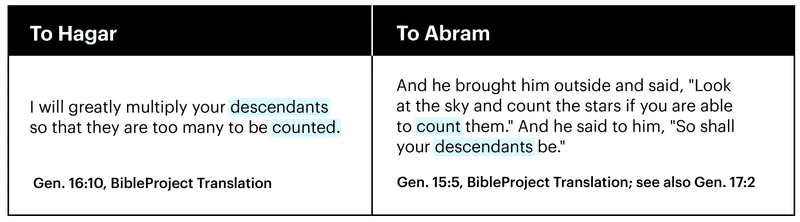

And God later says he will "bless" Hagar’s son Ishmael and “make him into a great nation” (Gen. 17:20), as he swore to do for Abram (Gen. 12:2). When God entered into a covenant agreement with Abram, he gave him three promises: descendants, blessing, and land—the promised land of Canaan (see Gen. 12:1-3; Gen. 12:7; Gen. 15:4-5; Gen. 15:7). Ishmael won’t inherit Canaan, which will go to Sarai’s future son, Isaac, but he will share in Abram’s covenant promises of descendants and blessing.
Years later, when God tells Abram (now called Abraham) to be circumcised as a sign of his covenant relationship with God, Ishmael gets circumcised too (Gen. 17:23-27), marking him as part of the same relationship. Hebrew Bible scholar Safwat Marzouk says the Bible presents multiple perspectives on “the inclusion/exclusion of Ishmael from the covenant,” which “invite us to resist simple categorizations of insider and outsider.”(2) God does not treat Ishmael as an outsider but as a good father might treat his beloved child, drawing him into the same promises he gives to Abram.
Hagar and Ishmael’s Exile
In spite of her distrust toward God and harmful behavior toward Hagar, Sarai (now called Sarah) eventually bears Isaac, the son God originally promised. But then a few years later, she sees Ishmael, now a teenager, doing something she dislikes. Many English translations say that Ishmael is “mocking” Isaac (Gen. 21:9), but the Hebrew verb used here, tsakhaq, can simply mean “to laugh.” And the name Isaac—Yitskhaq in Hebrew—comes from this verb (see Gen. 17:17-19, Gen. 21:1-7). So the biblical authors might be suggesting that Ishmael’s laughter means that he is Isaac-ing, that is, enjoying a status or privilege that Sarah wants only for Isaac.
Sarah is once again upset, and she demands that Abraham kick “this slavewoman and her son” out of the house so that Ishmael, Abraham’s firstborn son, won’t threaten Isaac’s inheritance (Gen. 21:10). Abraham doesn’t want to banish his own son (Gen. 21:11), but then—oddly—God tells him to do as Sarah said. This expulsion won’t destroy Ishmael because God has plans to make him into a great nation (Gen. 21:12-13).
By this point, Abraham has become quite wealthy, his household overflowing with silver and gold, flocks and herds, and male and female slaves (Gen. 12:16, Gen. 13:2, Gen. 14:14). But instead of sharing his resources to prepare his son for survival, he offers him only a little bread and a skin of water (Gen. 21:14). If Ishmael’s life and future depend on his human father’s provision, then he will die in the wilderness. But that’s not what happens. God is the greater, more trustworthy father to Ishmael, showing no partiality.
Hagar’s Exodus Deliverance
After their skin of water runs dry, Hagar and Ishmael are parched, lips cracking as they await their fate. Hagar can’t bear to watch her son die, so she leaves him alone under a bush before she crumples to the ground, weeping.
And in this place—shamed, rejected, and nearly dead—God draws near to Hagar. Fulfilling the meaning of Ishmael’s name, God “hears” the boy’s cries and meets with Hagar in the wilderness once again, reminding her that his promise is firm—he will do as he said and make Ishmael into a great nation (Gen. 21:17-18).
Then it says, “God opened her eyes and she saw a well of water” (Gen. 21:19, NIV). Despair often blinds us to reality, and Hagar had so far missed God’s provision. A later biblical character, Naomi, experiences similar blindness after her husband and sons die (see Ruth 1:1-5). Her daughter-in-law Ruth promises to stay with her no matter what, but Naomi says she has nobody at all (Ruth 1:16-21). Ruth is a divine gift during Naomi’s desperate need (see Ruth 4:15), and the well of water is a divine gift during Hagar’s desperate need. Yet both miss the blessing at first—they can’t see past their hopelessness, needing others to point out God’s provision.
Sarah intended to exile Hagar and Ishmael, but God works through Sarah’s actions to bring about deliverance. Notice how God first addressed Hagar both by her name and status: “Hagar, Sarai’s slavewoman” (Gen. 16:8). But as Hebrew Bible scholar Tammi Schneider observes, now he “refers to her only as Hagar. She is no longer anyone’s slave, confirmation that with her banishment from Abraham she is freed”(3) (see Gen. 21:17).
As many scholars have noted, Hagar’s experience as an Egyptian slave in Abraham and Sarah’s household shares striking parallels with the later Israelites enslaved in Egypt.(4)
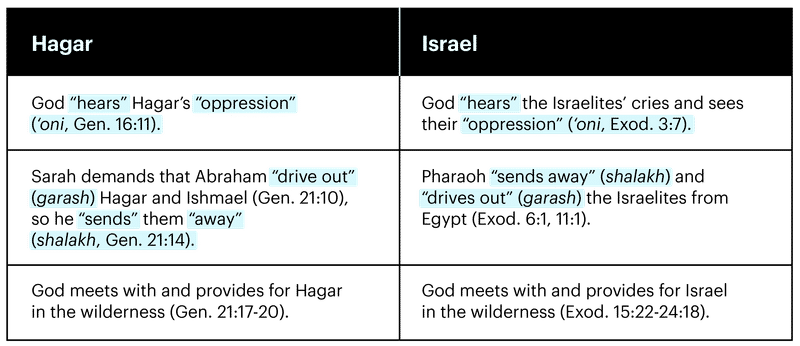

These parallels reveal that Hagar’s story is exodus-shaped, mirroring the story of Israel. And as God stays with the Israelites, he also stays with Ishmael. The once-threatening wilderness becomes a flourishing home because of God’s gift of life and his willingness to remain present, no matter what (Gen. 21:20).
God’s Impartial Love
Hagar’s story shows that God’s love and compassion don’t stop at the borders people draw. Abraham and Sarah failed to see Hagar’s dignity, but God saw, heard, and protected her, drawing her into his promises and remaining with her in the wilderness. The first parents of Israel missed their calling to bless the nations, yet God kept blessing anyway—because God’s love does not play by the rules of our us-versus-them games.
Through Hagar’s journey, we’re invited to see how all people—even the ones we’ve been told to push aside—are cherished by God. God sees, hears, and honors everyone created in his image, providing blessing and love. And he calls humans to relate to each other in the same way. Right relating, or righteousness, always heals and restores, never oppressing or shunning. It carries divine blessing to a scorned single mom in the wilderness and to all outcast “others” because God cares for people without favoritism.
- Terence E. Fretheim, Abraham: Trials of Family and Faith (Columbia: University of South Carolina Press, 2007), 105.
- Safwat Marzouk, "Interrogating Identity: A Christian-Egyptian Reading of the Hagar-Ishmael Traditions," in Colonialism and the Bible: Contemporary Reflections from the Global South, ed. Tat-siong Benny Liew and Fernando F. Segovia (Lanham, MD: Lexington, 2018), 3.
- Tammi J. Schneider, Mothers of Promise: Women in the Book of Genesis (Grand Rapids: Baker Academic, 2008), 117.
- See Marzouk, "Interrogating Identity," 11-13; Katharine Doob Sakenfeld, Just Wives? Stories of Power and Survival in the Old Testament and Today (Louisville: Westminster John Knox, 2003), 10; Fretheim, Abraham, 96-105; John T. Noble, A Place for Hagar's Son: A Case Study in the Priestly Tradition (Minneapolis: Fortress, 2016), 18.