The Books of Samuel
About
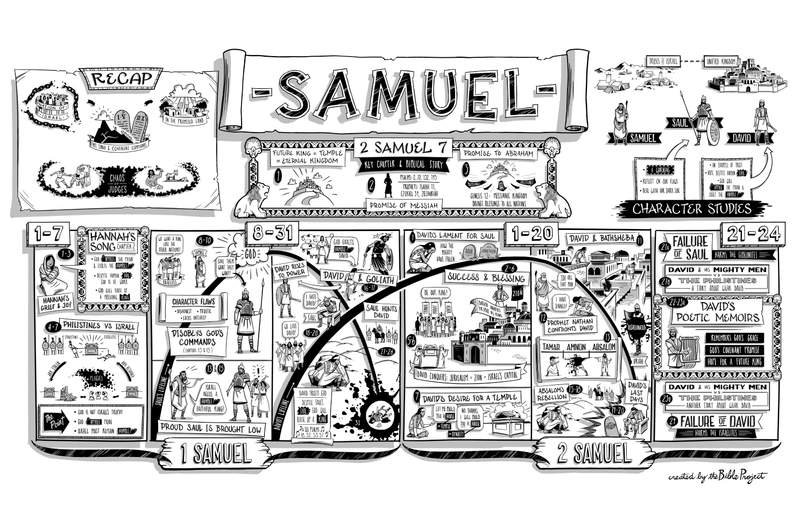
The books of Samuel were originally written as one coherent story, but due to the length of the work, they are separated into two books in our modern Bible.
After the nation of Israel was rescued from slavery in Egypt and made a covenant with God at Mount Sinai, they eventually came into the promised land. There, Israel was supposed to be faithful to God and obey the covenant commands, but the book of Judges shows how Israel failed big time. It was a time of moral chaos that showed Israel’s need for wise, faithful leaders. The books of Samuel provide an answer to that need.
The story focuses on three main characters: Samuel, Saul, and David. These three were important leaders whose actions would transition Israel from a group of tribes ruled by judges into a unified kingdom ruled by King David in Jerusalem.
The books have a fascinating design that weaves the stories of these three characters together through four parts (1 Sam. 1-7 and 8-31; 2 Sam. 1-21 and 22-24). Samuel is a key leader and prophet through the first section of the book (1 Sam. 1-7), and he continues to play a key role in the next section. Saul’s story (1 Sam. 8-31) is told in two movements: his rise to power and some huge failures (1 Sam. 8-15), followed by his downfall and tragic death (1 Sam. 16-31). The drama of Saul’s demise is matched by David’s own exciting rise to power (1 Sam. 16-31). David’s story is also told in two movements. He first rides the wave of success (2 Sam. 1-9), followed by his own tragic failure and the slow self-destruction of his family and kingdom (2 Sam. 10-20). All this is concluded by an epilogue (2 Sam. 21-24) that reflects back on the whole story.
1 Samuel 1-7: Hannah and the Rise of Samuel
Part one picks up from the chaos shown in the book of Judges. We are introduced to the touching story of a woman named Hannah who is grieved because she has never been able to have children. By God’s grace, she finally has a son, Samuel, and in joy she sings an amazing poem in chapter 2. She sings about how God opposes the proud and exalts the humble, how, despite human evil, God is working out his purposes, and how God will one day raise up an anointed king for his people. Hannah’s poem has been placed at the beginning to introduce themes that we will see throughout the story.
Hannah’s son Samuel grows up to become a great prophet and leader for the people of Israel as the Philistines rise to power as their enemy (1 Sam. 4-7). In a crucial battle, the Israelites become arrogant, and rather than praying, they trot out the ark of the covenant as a kind of magical trophy that will grant them victory in battle. Because of their pridefulness and presumption, God allows Israel to lose the battle, and the ark is stolen. The Philistines take the ark and place it in the temple of their god, Dagon. The God of Israel responds by thoroughly defeating the Philistines and their idols without an army, by sending plagues on them. At this, the Philistines send the ark back to Israel. The point is clear—God is not Israel’s trophy, and he opposes pride among both the Philistines and the Israelites. Israel is to remain humble and obedient if they want to experience his covenant blessing.
1 Samuel 8-31: The Downfall of Saul and Rise of David
We continue right on into the next large section (1 Sam. 8-31), in which the Israelites go to Samuel and demand a king “just like all the other nations have.” Samuel is rightfully angry at this, and he goes to consult God, who responds by saying that, though their motivations are wrong, if it is a king they want, it will be a king they get. From there, we are introduced to Saul.
Saul is a tragic figure who is full of promise, tall, and good looking. He seems like a great candidate for a king, but he has deep character flaws. He’s dishonest, lacks integrity, and is unable to acknowledge his mistakes. These traits become his downfall. While he wins some battles, his flaws run so deep that he disqualifies himself by blatantly disobeying God’s commands (1 Sam. 13 and 15).
The now aging Samuel confronts both Saul and Israel. He had warned the people that they would only benefit from a king who was humble and faithful to God, or else their kings would bring ruin. He then turns to Saul and informs him that God is going to raise up a new king to replace him (1 Sam. 15).
So Saul’s downfall begins as God works behind the scenes to raise up this new king, an insignificant shepherd boy named David. He is the least likely candidate to be king, but through the famous story of David and Goliath (1 Sam. 17), we are shown that God’s choice of David is not based on his status but rather his radical and humble trust in the God of Israel. This story embodies themes in Hannah’s poem—the proud Saul and Goliath are brought low while the humble David is exalted.
In 1 Samuel 18-31, we watch Saul slowly descend into madness while David rises to power. David works for Saul as a general, winning all his battles and gaining all the fame. Saul quickly becomes jealous and starts hunting David down in order to kill him. David, however, has done nothing wrong and simply runs away and waits. This shows his true character. Despite multiple opportunities to kill Saul, he doesn’t. Instead, he trusts that despite Saul’s evil, God will raise up a king for his people. Many of David’s poems in the book of Psalms are linked to this very period of his life (Ps. 18; Ps. 52; Ps. 54; Ps. 57; Ps. 59, and 63). This section ends with Saul, having failed to find and kill David, coming to a grisly death himself after losing a battle with the Philistines.
The book of 1 Samuel contains some of the most intricately told stories in the Bible, and the characters are portrayed very realistically. The author puts them forward as character studies, so that you may find yourself in them. In Saul’s story, we see a warning. It’s crucial that we reflect on our own character flaws and how they harm us as well as others. We can see how we need to humble ourselves and, with God’s help, deal with our dark sides. David is presented as an example of patience and trust in God’s timing in our lives. As he was being chased by Saul, David had every reason to think God had abandoned him, but he didn’t. In fact, his story encourages us to trust that, despite human evil, God is working out his purpose to oppose the proud and exalt the humble.
2 Samuel 1-20: God’s Covenant With King David (and David’s Failure)
The second book of Samuel picks up after Saul’s death, and David surprises everyone by composing a long poem lamenting the death of the man who tried to murder him. Once again, the author shows David’s humility and compassion. He is a man who grieves the death of even his enemies.

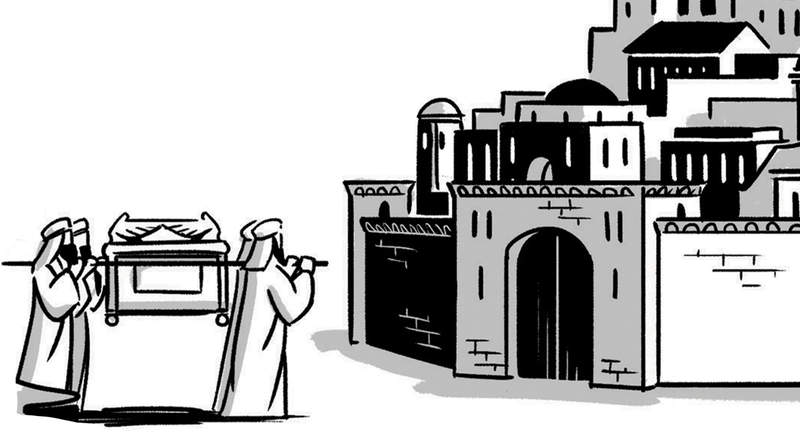
David goes on to experience a season of success and divine blessing. The Israelite tribes all come to David and ask him to unify the tribes as their king. He accepts, and the first thing he does as king is go to Jerusalem, conquer it, establish it as Israel’s capital city, and rename it Zion. From there, David continues to win many battles and expand Israel’s territory.
After David had made Jerusalem the political capital of Israel, he also wanted to make it their religious capital, so he had the ark of the covenant moved into the city (2 Sam. 6). David then tells God that if Israel now has a permanent home, God’s presence should also have a place to inhabit, so he asks if he can build a new temple for him. However, God says to David, “Thanks for the thought, but actually I’m going to build you a house—a dynasty.”
Now, this is a key chapter for understanding the storyline of the entire Bible. God makes a promise to David that, from his royal line, there will come a future king who will build God’s temple on Earth and set up an eternal kingdom. It’s this messianic promise to David that gets developed more in the book of Psalms (Ps. 2; Ps. 72; Ps. 132, and 145) and in the Prophets (Isa. 11; Ezek. 34; and Zechariah). It’s this king that is connected to God’s promise to Abraham (Gen. 12). The future messianic Kingdom will be how God brings blessing to all nations.
This is a high point for David. And, sadly, it’s right here in the midst of God’s blessing that things go terribly wrong. David makes a fatal mistake—not fatal for him, that is, but for a man named Uriah, one of David’s prized soldiers. From his rooftop, David sees Uriah’s wife, Bathsheba, bathing. David finds her, sleeps with her, and gets her pregnant. Then, he tries to cover it all up by having Uriah assassinated and marrying her as soon as she’s widowed.
When David is confronted by the prophet Nathan, he immediately owns up to what he’s done. He’s broken and repents, asking God to forgive him. And God does forgive, but he doesn’t erase the consequences of David’s decisions. As a result of his horrible choices, David’s family starts to fall apart, making this section a tragic story much like Saul’s.
David’s sons end up reliving their father’s mistakes, but in even worse ways. Amnon sexually abuses his sister Tamar, and when their brother Absalom finds out, he has Amnon assassinated (2 Sam. 13). Absalom then hatches a plot to oust his own father from power, and he launches a full-scale rebellion (2 Sam. 15).
So, for a second time, David is forced to run from his own home and hide in the wilderness, except this time he’s not innocent. The rebellion ends when David’s son is murdered (2 Sam. 18), and this breaks David’s heart. Once again, he laments over those who tried to kill him. David’s last days find him back on his throne but as a broken man, wounded by the sad consequences of his sin.
2 Samuel 21-24: Epilogue and the Hope for a Greater David
The books of Samuel conclude in chapters 21-24 with a well-crafted epilogue. The stories are out of chronological order because they’ve been given a symmetrical literary design. The outer pair of stories (2 Sam. 21a and 24) come from earlier in David’s reign and compare the failures of Saul (2 Sam. 21a) and David (2 Sam. 24), as well as how they hurt others through their bad decisions.
The next pair of stories (2 Sam. 21b and 23b) are about David and his band of “mighty men” fighting the Philistines. What’s interesting is that both sections have a story of David’s weakness in battle. In contrast to the stories of the heroic, victorious David, here we see a vulnerable David who is dependent on others for help.

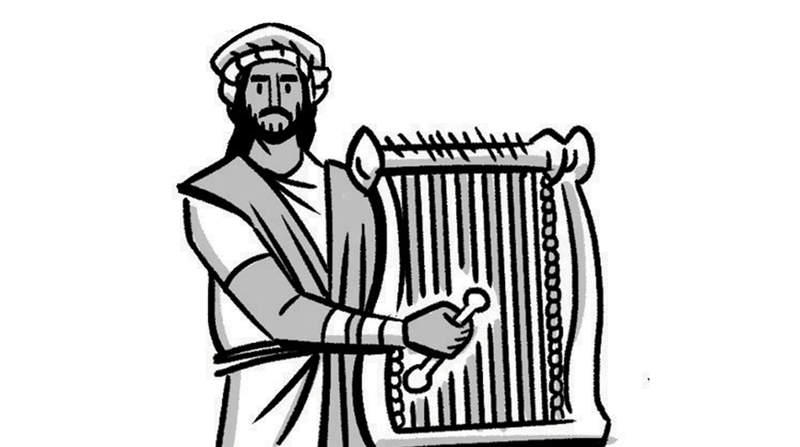
The center of the epilogue has two poems that act like memoirs as David reflects on his life (2 Sam. 22 and 23a). He remembers times when God graciously rescued him from danger and sees this as an expression of God’s covenant promise, not just to him but to all the world. Both of the poems reflect back on the hope for the future messiah who will build an eternal Kingdom.
David’s concluding poems also connect back to Hannah’s song that opened the book of 1 Samuel. These poems, at the beginning and end and in 2 Samuel 7 in the center of the book, bring together all the key themes and ideas. Despite Saul and David’s evil, God has been at work carrying out his purposes. God opposed their arrogance time after time, and when David humbled himself, he was exalted. By the book’s conclusion, the future hope of the final poems reaches far beyond David himself, looking to the future messiah who will bring God’s Kingdom and blessing to all nations.
Frequently Asked Questions
Here are some of the most common questions people ask online about this book.
In the Bible, Samuel is known for being a prophet, a priest, and Israel’s final judge (1 Sam. 1-7). He plays a significant role in Israel’s transition from a period of judges (i.e., regional, political, and military leaders), ruling the people until the establishment of the monarchy, wherein Samuel anoints Israel’s first two kings, Saul and David. Samuel is also known for his dedication to God from a young age, living and serving in the temple at Shiloh under Eli the priest. Throughout his life, Samuel remains faithful to God and serves as a just and righteous judge for the Israelite people (1 Sam. 12:4).
Samuel anointed Saul and David to be king, but what does anointing mean? Learn more about the theme of anointing in the Bible in the video Anointing and the podcasts Saul the Anti-Anointed and The Anointed King in Psalms.
The biblical authors present Samuel as a good (even great!) leader in the Bible (1 Sam. 3:19-21). Unlike the partially negative way authors describe many key figures or leaders in the Bible, such as Abraham (e.g., Gen. 12:10-21; Gen. 16) and Moses (e.g., Num. 10:10-13), they do not record any stories about moral failures or mistakes by Samuel. From a young age, Samuel serves as a faithful and obedient servant of God, wisely guiding and leading the Israelite people and anointing the first two kings of Israel, Saul and David.
The story of Samuel teaches us that God opposes the proud, exalts the humble, remains faithful in spite of human evil, and that he promises the arrival of a future king. The biblical authors explore these themes in the book through the character of Saul, his rise to power, and the exposure of his character flaws as he disobeys God’s commands.
In contrast to the prideful character of Saul, God raises up David, a humble shepherd boy who faithfully trusts in God. We see these two characters in increasingly stark contrast. Saul slips into madness as David resolutely trusts in God’s timing and purposes. Eventually, we see David succeed and fail, much like Saul. The story emphasizes God’s faithfulness despite Saul and David’s failures and God’s promise of a future king who, unlike both Saul and David, will come and perfectly fulfill God’s good purposes on Earth.
Discover more about how God repeatedly blesses and anoints the second-born, the late-comer, and the “least likely,” in the video The Last Will Be First and the podcast David, the Latecomer King. And learn more about Samuel’s warning to the Israelites and King Saul’s reign in the article Saul: A Tale of Deception.
It is likely that Samuel did not cut his hair because of his mother’s vow to God that no razor would ever be used on his head (1 Sam. 1:11). The vow to not cut one’s hair is part of the voluntary Nazarite vow described in Numbers 6:1-21, and it required observers to abstain from wine, refrain from cutting their hair, and to stay away from corpses or graves. Samuel is not described in the Old Testament as being a Nazarite, but it is possible that Samuel followed the other Nazarite requirements in addition to not cutting his hair. We don’t know for certain.
Learn more about Samuel’s mom, Hannah, and her incredible poem in Hannah’s Poem and Power Reversals. And to learn more about the Nazarite vow, check out the podcast What’s a Nazarite Vow?
The biblical authors explain that the sons of Samuel were rejected as leaders over Israel because they did not follow in Samuel’s ways. Although we aren’t given details, we are told that Samuel’s sons pursued dishonest gain, accepted bribes, and perverted justice (1 Sam. 8:3).
The book of Samuel gets its name from the character of Samuel, who plays a significant role in the early parts of the narrative with the stories of his birth and of his childhood serving in the temple at Shiloh under Eli the priest. The book opens with the story of Samuel’s mother, Hannah, and follows Samuel’s birth, childhood, and his growth into the role of judge, prophet, and priest in Israel who eventually anoints Israel’s first two kings, Saul and David. It’s called the book of Samuel because, in large part, the book begins with a man named Samuel and details other significant events that took place in his day.
No biblical author claims that 2 Samuel 7 is the most important chapter in the Bible. However, the events of this chapter become significant in the remainder of the biblical story. Here God makes a promise to David that a future king will come from his royal bloodline, one who will build God’s temple on Earth and set up an eternal kingdom. This promise to David gets developed more in the book of Psalms (see Ps. 2; 72; 132; 145) and in the books of the Prophets (see Isa. 11; Ezek. 34; Zech.). Additionally, the biblical authors connect this future king to God’s promise to Abraham (Gen. 12) that through his descendants, God will bring blessing to all nations. While there is no “most important” chapter in the Bible, 2 Samuel 7 does become a foundational passage as the story of Scripture develops beyond the events described there.
Learn more about King David in the article David: What’s the Big Deal? Discover more about the theme of the Messiah in the video Messiah and the theme of covenant in the video The Covenants.
The Bible does not specify Samuel’s age when he died. However, we can infer that Samuel lived to an old age from his self-description of being “old and gray” during the years leading up to his death (1 Sam. 12:2).
In 2 Samuel, David’s sins include sexual assault, murder, lying, failing to trust God for protection, and ignoring evil within his own family. In one example, David sees a woman named Bathsheba bathing on her rooftop (2 Sam. 11). David uses his royal power to isolate and rape her, gets her pregnant, and tries to cover everything up by having her husband killed and immediately marrying her. Later on, David fails to discipline his son Amnon for raping his own daughter Tamar, leading to his other son, Absalom, trying usurp the throne (2 Sam. 13-18). And at one point, David decides to conduct a military census of the people of Israel in 2 Sam. 24, which displays his lack of trust in God's protection and provision. As the story progresses, and as a result of David’s sinful choices, we see his family and kingdom continue to fall apart.
Learn more about David and his rise and fall as Israel’s king in the video David the Priestly King.
The main message of 2 Samuel includes an appeal to the virtue of humility, the destructiveness of pride, and the faithfulness of God’s promise. Throughout the book, we see David succeed and fail repeatedly. And as the kingdom of Israel slowly unravels, the final chapters of 2 Samuel highlight moments of David’s weakness, while also promising another king who will come to fulfill God’s good purpose and promise given to David and Abraham to bless all nations (Gen. 12:1-3; 2 Sam. 7).
Explore the theme of God’s faithfulness to David and to others throughout the Bible in the video Faithful.